Graphene Block
Features of Graphene Block
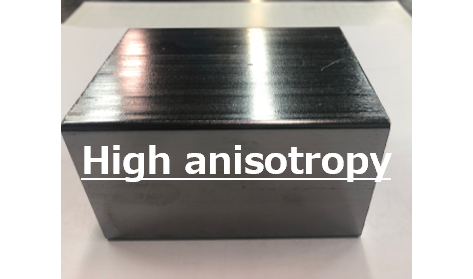
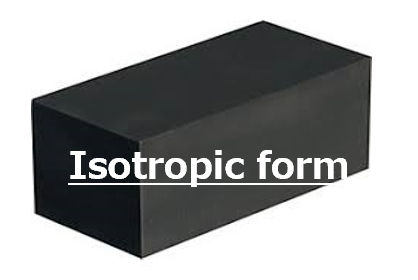
The Graphene Block is a high-performance graphite block manufactured using graphene as a raw material and produced through a proprietary forming technology. Conventional graphite blocks (isotropic graphite) have an isotropic structure and offer excellent mechanical strength. However, their thermal and electrical conductivity are generally inferior to those of metals. In contrast, the Graphene Block exhibits extremely high anisotropy and excellent crystallinity, providing exceptionally high thermal conductivity and electrical conductivity compared with conventional graphite blocks (isotropic graphite). It also has a low coefficient of kinetic friction, giving the material distinctive performance characteristics as a solid lubricant. Furthermore, the combination of high ultrasonic attenuation and high thermal conductivity makes the Graphene Block particularly useful as a backing material for ultrasonic probes, where efficient dissipation of heat generated by the ultrasonic transducer is required.

Comparison with Conventional Graphite Materials
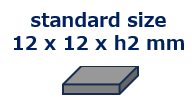
| Graphite Block | Isotropic Graphite | HOPG(Highly-oriented Pyrolytic Graphite) | |
|---|---|---|---|
 |
 |
 |
|
| InALA product | conventional material | conventional material | |
| Orientation | anisotropic | isotropic | anisotropic |
| Bulk density (g/cm3) | 2.2 | 1.7~1.9 | 2.2 |
| Magnetic Susceptibility 1) (x10-6) | orientation axis (Z) -456 | arbitrary -122 | orientation axis (Z) -450 |
| non-oriented axis (X) -72 | |||
| non-oriented axis (Y) -87 | |||
| Thermal Conductivity (W/m・K) | 800~1000 2) | 70~150 3) | 1000~1800 3) (100~12μm) |
1)Large negative magnetic susceptibility value means high crystal orientation
2)InALA electrical-to-thermal conductivity conversion method
3)Literature value
2)InALA electrical-to-thermal conductivity conversion method
3)Literature value
Machined Graphene Block Components
Features of Machined Graphene Block Components
Graphene Block is a high-performance graphite block manufactured from graphene using our proprietary forming technology.
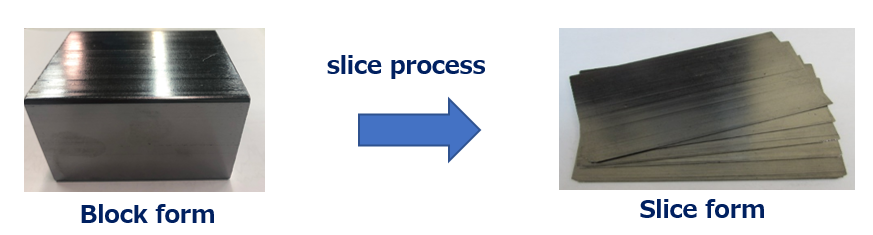
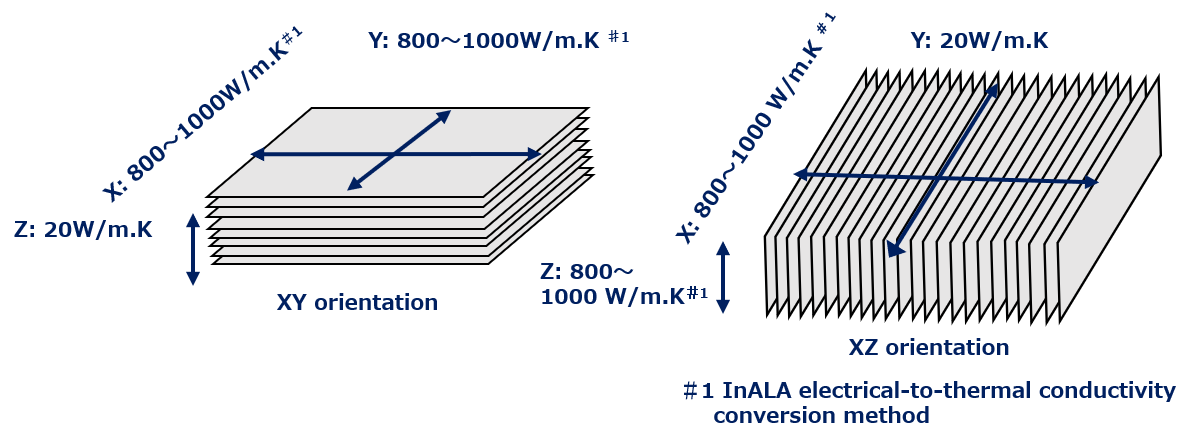
Because plates are produced by slicing them from the block, the direction of thermal conductivity can be controlled by changing the orientation in which the plates are sliced. Depending on the slicing orientation, components can be produced with high thermal conductivity either within the in-plane direction or and the thickness direction.
Because plates are produced by slicing them from the block, the direction of thermal conductivity can be controlled by changing the orientation in which the plates are sliced. Depending on the slicing orientation, components can be produced with high thermal conductivity either within the in-plane direction or and the thickness direction.
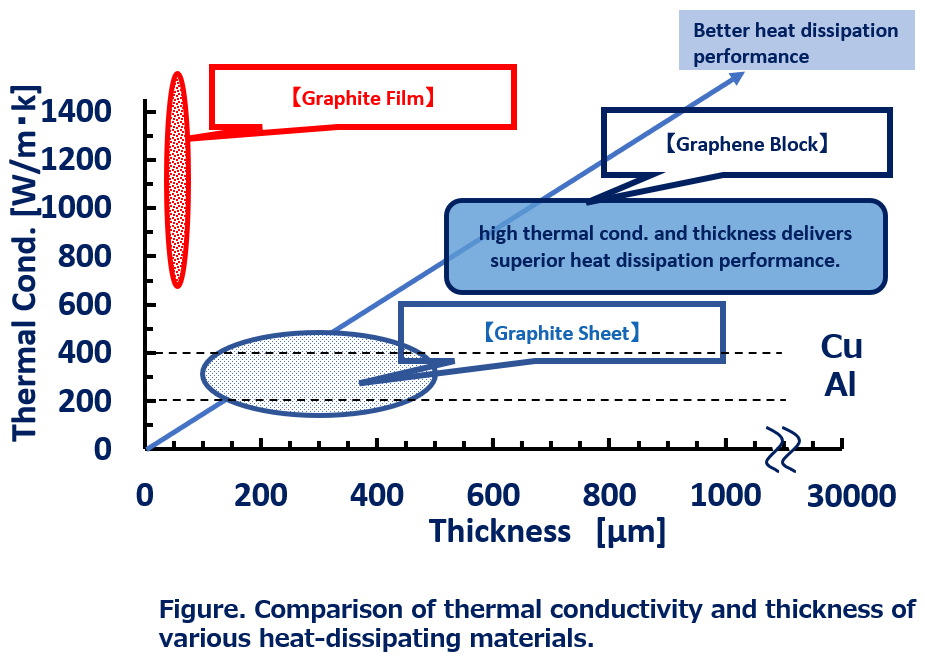
The amount of heat that a heat-dissipating material can transfer depends not only on its thermal conductivity, but also on its “thickness.” In general, a thicker component can transfer a greater amount of heat. Conventional graphite-based heat-dissipation materials face a trade-off: materials with high thermal conductivity are typically restricted in thickness, while thicker materials tend to have lower thermal conductivity. As a result, their applications have been relatively limited.
By using graphene as a raw material and processing it into high-density, highly anisotropic graphite, our graphene block components can be manufactured with thicknesses more than 100 times greater than conventional products. This enables high heat dissipation performance in general-purpose applications where graphite-based thermal components were previously difficult to utilize.
Thermal conductivity direction can be controlled by the slicing orientation
Advantage of Machined Graphene Block Components
Applications of Machined Graphene Block Components
Heat dissipation, heat transfer, cooling, and heat exchange components used in general-purpose PCs, industrial PCs, data centers, LEDs, EVs, automotive electronics, semiconductor manufacturing equipment, machine tools, robotics electronics, etc.
Heat dissipation and cooling components for inverters, power semiconductors, and similar devices.
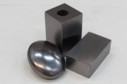
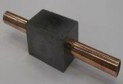
Application examples: heat dissipation, heat transfer, cooling
 |
 |
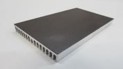 |
| heat spreader(thin plate) | heat spreader-metal hybrid | heat spreader-heat sink hybrid |
 |
 |
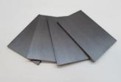 |
| heat transfer parts | heat exchanger(water cooling) | heat spreader(thick plate) |
Specifications for Machined Graphene Block Components
Specifications for Machined Graphene Block Components
| Product type | Machined Graphene Block Components | ||
|---|---|---|---|
| XY | XZ | ||
| Thermal Conductivity [W/m・K] | in-plane direction | X・Y : 700~1000#1 | X : 700~1000#1 Y : 20 |
| thickness direction | Z:20 | Z:700~1000#1 | |
| 線膨張係数[1/K] (室温~400℃) |
in-plane direction | X・Y:1~4×10⁻⁶ | X:1~4×10⁻⁶ |
| Y :30~50×10-6 | |||
| thickness direction | Z:30~50×10-6 | Z:1~4×10⁻⁶ | |
| Heat-proof temperature [℃] | in air | 500 | |
| inert gas | 3000 | ||
| Specific Heat [J/(g・K)] | 0.76 | ||
| Emissivity | 0.8 | ||
| Bulk Density[g/cm3] | 2.2 | ||
| Bending Strength [MPa] | 10 | 8~12 (due to orientation 2) |
|
| Flexural modulus [MPa] | 1000 | 1000 (not measurable due to orientation) | |
| Compressive Strength [MPa] | 20 | 12 | |
| Specific Resistance [Ω・cm] | XY : 10-4 | XZ : 10-3 | |
| Vickers Hardness [HV] | 4.5 | 7.2 | |
| Surface Roughness | Rz=20µm | Rz=10µm | |
| Composition | carbon only | carbon only | |
| Model No. | Thermal Conductivity#1 | Thermal Conductivity#2 | Bending Strength | Maximum Size(mm) | Minimum Thickness(mm) | ||
|---|---|---|---|---|---|---|---|
| (W/m.K) | (W/m.K) | (MPa) | XY | XZ | XY | XZ | |
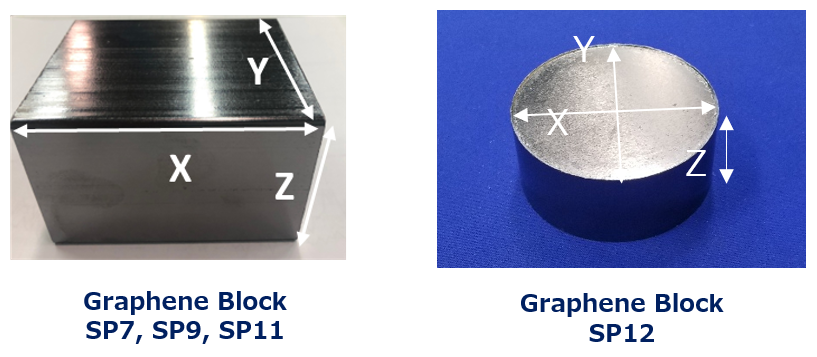
| SP7 | 700 | 450 | 12 | 127×76 | 127×100 | 0.5 | 1.5 |
| SP9 | 800 | 500 | 10 | 100×70 | 100×100 | 0.5 | 1.5 |
| SP11 | 900 | 600 | 8 | 100×70 | 100×100 | 0.5 | 2.0 |
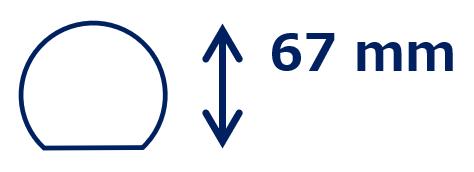
| SP12 | 1000 | 700 | 8 | Φ70#3 48×48 | 48×30 | 0.5 | 2.0 |
#1 InALA electrical-to-thermal conductivity conversion method
#2 Xenon Flash (vertical) method
#3 Due to the manufacturing process, the shape is partially cut (see figure on the below).
#2 Xenon Flash (vertical) method
#3 Due to the manufacturing process, the shape is partially cut (see figure on the below).
Coating of Machined Graphene Block Components
We offer various coating solutions to address issues specific to graphite (carbon), including dust generation and electrical insulation requirements.
Dust-Prevention and Insulation Coating
| No Coating | High-strength Coating | Dust-prevention / Insulation Coating | |
|---|---|---|---|
| Surface Resistivity [Ω/□] | 10-4 | 102 | 1013 |
| Flexural Elasticity [MPa] | XY : 1000 | XY : 1000 | XY : 970 |
| Compressive Strength[MPa] | XY : 20 | XY : 32 | – |
| Bending Strength [MPa] | XY : 10 | XY : 20 | XY : 10 |